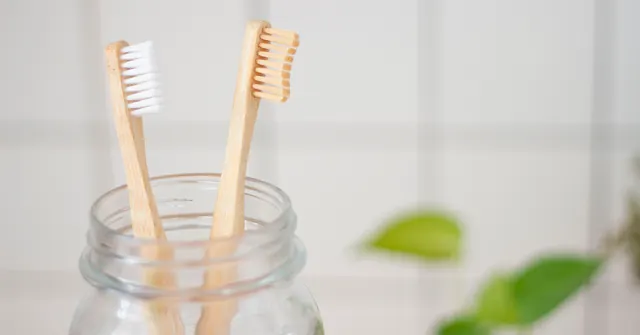

Beyond eating too much sugar in the form of sweets, fizzy drinks and the like, there are habits we often pay little attention to that, over time, can seriously damage the mouth. Let’s look at what they are.
Since childhood we have been taught how important it is to brush our teeth at least three times a day, as soon as we get up in the morning and after our main meals, and perhaps we have also learnt to cut down on sweets, cakes and sugary fizzy drinks.
There are, however, some very common and apparently harmless habits that can damage our smile and increase the risk of tooth decay, gingivitis and other problems.
Why is using a toothpick bad for your gums?
How many of you have felt a bit of food stuck between your teeth, especially after eating high-fibre foods? Probably all of us. Our first reaction is to get rid of it as quickly as possible with a toothpick, but this is far from a harmless gesture, and an unsightly one too.
The pointed, rigid shape of a toothpick can injure the gums and, over time, flatten the gingival papillae (the part of the gum that fills the gap between one tooth and the next), leaving the teeth more exposed to infection. What is more, the wood a toothpick is made of is highly permeable to water: in contact with saliva it can soften and break, and a splinter may end up lodged in the gum without our noticing, causing infections or injuries.
In these situations it is much better to use dental floss or an interdental brush, a tool designed specifically to clean the wider spaces between the teeth and remove food debris and bacterial plaque. Its tapered tip, covered in soft bristles, is designed to slip into the interdental spaces and clean them gently. Interdental brushes come in different sizes: choose one according to how wide the spaces between your teeth are, bearing in mind that the head of the brush must slide easily between the teeth without injuring the gums. Interdental brushes can be used several times, until the bristles wear out; the important thing is to rinse them thoroughly and leave them to air-dry.
How does nail biting affect your teeth?
Onychophagia, the scientific term for nail biting, is a very common disorder, especially among young people (children and teenagers), but sometimes in adults too. It can be linked to stress and other emotional problems. This behaviour can be very harmful, not only to the nails, which become weaker and can develop wounds and infections around them, but also to the health of the teeth and mouth.
In young people, whose tissues and bones are still growing and forming, nail biting can lead to misalignment of the dental arches and, as a result, malocclusion. The repeated contact between the teeth can cause problems in the muscles and joints of the jaw. And that is not all: the front teeth, the incisors, wear down quickly and their edges look jagged and abraded.
People who bite their nails also show a great deal of gum damage and infection, caused by constant contact with the germs and bacteria on the hands, and therefore periodontal problems too.
Nail biting is often an unconscious behaviour and therefore hard to control. Even so, it is important to become aware of the problem and look for a solution, such as chewing sugar-free gum to release tension and applying a nail polish containing denatonium benzoate, a very bitter substance that helps to curb the habit.
To protect tooth enamel, it is advisable to brush with a toothpaste containing fluoride and isomalt, which will not only help to protect and strengthen the enamel but also remove any stains on its surface.
To prevent gum inflammation or infection, on the other hand, remember to complete your daily oral care routine with dental floss and a mouthwash, to remove food debris from between the teeth and plaque along the gum line.
Photo: Kat Smith on Pexels